No products in the cart.
How to Declutter Your Kitchen Counter in One Weekend
Home Organisation · 2026
How to Declutter Your Kitchen Counter in One Weekend
The counter is the battleground of every kitchen. Here is a proven two-day method to clear it completely — and a system to keep it clear for good.
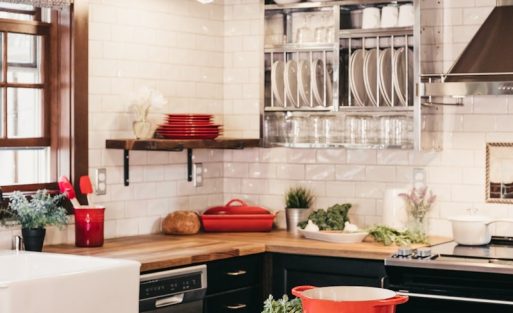
Walk into almost any American kitchen and you will encounter the same scene: a coffee maker that never moves, a fruit bowl that is mostly decorative, three appliances plugged in and used twice a year, a pile of mail that somehow migrated in from the hallway, and approximately one usable square foot of actual prep space. The kitchen counter has become the default dumping ground of the modern home — and it is costing more than most people realise.
Research from UCLA’s Centre on Everyday Lives of Families found that women in cluttered homes showed measurably higher cortisol levels throughout the day, with the kitchen identified as a primary stress hotspot. Beyond the psychological toll, a cluttered counter has real practical consequences: it slows every meal preparation session, creates food hygiene risks around raw ingredients, and makes the entire kitchen feel smaller regardless of its actual square footage. The average cluttered American kitchen counter has over twelve items on it at any given time — and fewer than four of those are touched daily. According to Good Housekeeping, a systematic decluttering approach — starting with a full counter clear-out before reintroducing only daily-use items — is the most effective way to achieve lasting kitchen organisation.
The good news is that the kitchen counter is one of the most transformable spaces in your entire home. It responds faster than almost any other area to a structured, methodical approach. This weekend guide gives you a clear two-day process, the mental model to maintain it long-term, and the specific tools that make the difference between a declutter that lasts one week and one that holds for years.
“Kitchen organisation is not about perfection — it is about reducing the number of micro-decisions you make every time you cook. A clear counter is a clear mind.”
— Marie Kondo, The Life-Changing Magic of Tidying Up
— Marie Kondo, The Life-Changing Magic of Tidying Up
📋 In This Guide
Why Counters Get Cluttered: The Real Reasons
Before you can fix a problem permanently, you need to understand the specific mechanisms driving it. Kitchen counter clutter is not random — it follows predictable, identifiable patterns rooted in how we interact with our spaces.
The path of least resistance: Objects land on the counter because it is the first available horizontal surface you reach when entering the kitchen with something in your hands. Mail, keys, school bags, phone chargers, and medication all end up there by default — not because the counter is the logical home for any of these things, but because placing them there requires zero effort or decision-making. Without an alternative landing zone, the counter wins every time.
Appliance permanence bias: We leave appliances on the counter because moving them feels like admitting we do not use them enough to justify their presence. The toaster that gets used twice a week, the stand mixer that appears four times a year — they occupy prime real estate indefinitely because storing them in a cabinet feels like a defeat. In reality, an appliance you retrieve from a lower cabinet is still fully accessible; it simply no longer charges you counter space every single day of the year.
The “I might need it” accumulation trap: Condiments, supplements, a fruit bowl, a knife block, paper towels, dish soap — each item in isolation has a perfectly reasonable justification for being out. The problem is that each item also carries a cost: visual noise, reduced prep surface, and a counter that is harder to wipe clean. When you add up ten “reasonable” items, the working workspace disappears completely.
The maintenance gap: Most households declutter the kitchen counter during a deep clean and then watch it fill back up within seven to ten days. Without physical systems that make it easier to put things away than to leave them out, the natural entropy of daily household life always wins. Organisation without infrastructure is just temporary tidying.
The One-Weekend Declutter Method
This method distributes the work across two days so it is genuinely achievable without burning out, and moves from broad macro decisions on Saturday to specific micro installations on Sunday for maximum lasting effect.
Saturday: Clear and Categorise
Begin by removing everything from every counter surface in your kitchen. Not most things — everything without exception. Appliances, utensil crocks, soap dispensers, fruit bowls, the knife block, the coffee machine, the paper towel holder. Place the entire collection on your kitchen table or dining floor so you can see the full inventory at once in one place. This physical separation from the counter is psychologically critical — it breaks the assumption that items simply belong there, and forces you to make a conscious, active decision about each one rather than defaulting to the status quo.
Now sort every item into four honest categories: Daily Use (physically touched every single day), Frequent Use (used three or four times per week), Occasional Use (weekly or less), and Rarely or Never (be ruthless here). The Rarely or Never pile goes directly into a donate box or long-term storage. The Occasional Use pile moves to cabinet storage. The Frequent Use items earn cabinet access with good placement. Only Daily Use items earn consideration for returning to the counter — and even those must pass a further test on Sunday.
Sunday: Organise and Install
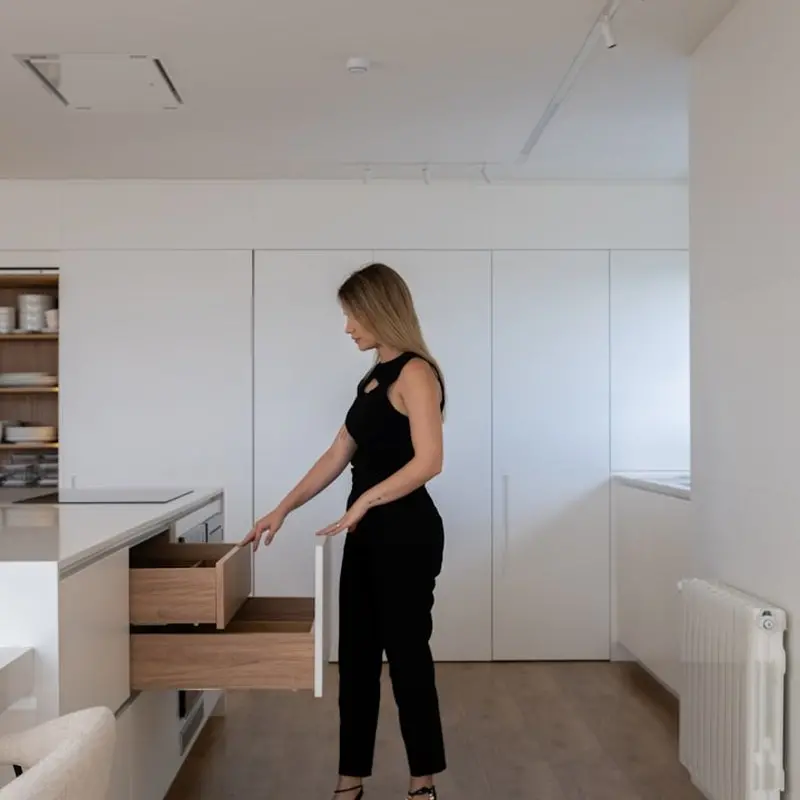
Sunday is about creating permanent systems rather than relying on willpower. Install the physical storage solutions that make the new arrangement self-sustaining — wall-mounted knife storage, a self-draining sink caddy, fridge-door mounted dispensers, cabinet door organisers. Assign a dedicated “landing zone” outside the kitchen for the non-kitchen items that routinely migrate in — a small hook or shelf near the kitchen entrance intercepts keys, mail, and bags before they reach the counter. Deep-clean the counter surface. Then return only the items that passed Saturday’s Daily Use standard, positioned deliberately for workflow rather than habit.
The “Earn Your Counter Space” Rule — What Stays and What Does Not
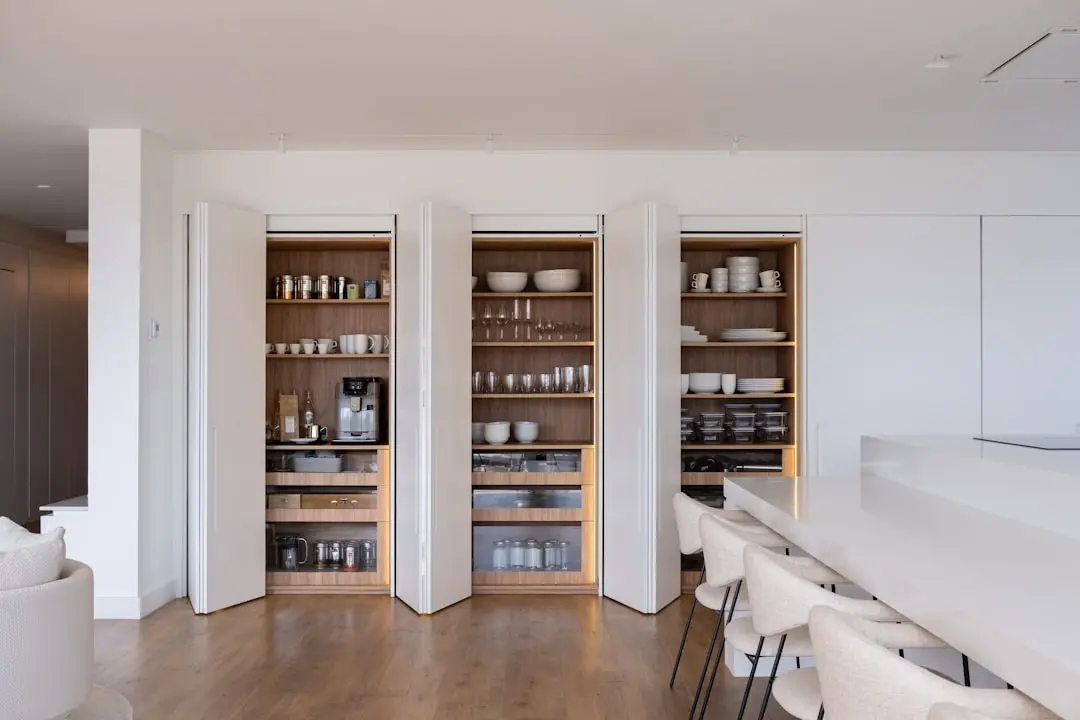
The most effective long-term mindset shift for counter clarity is this: counter space is premium real estate, not a free-for-all surface. Every object on your counter should earn its position by meeting at least two of these three criteria:
- Used daily — You physically interact with it every single day without exception.
- Genuinely impractical to store — Its size or weight makes cabinet access a real inconvenience, not just a mild preference.
- Functionally essential to workflow — Its presence on the counter meaningfully speeds up meal preparation in a way that cabinet access genuinely cannot replicate.
Test every item honestly against this standard. Your coffee maker probably qualifies on all three counts. The decorative ceramic jar does not. The paper towel holder might qualify daily-use-wise, but a paper towel mounted under the upper cabinet with a simple bracket frees the same footprint while remaining equally accessible. The knife block almost certainly fails criterion two and three if you switch to a wall-mounted magnetic strip — the knives become more accessible, not less, while freeing six to eight inches of counter space permanently.
12+
average items on a US kitchen counter, with only 3–4 touched on a daily basis
average items on a US kitchen counter, with only 3–4 touched on a daily basis
27 min
average time lost weekly searching for misplaced kitchen items in cluttered kitchens
average time lost weekly searching for misplaced kitchen items in cluttered kitchens
77%
of Americans feel stressed or overwhelmed by kitchen clutter at least once a week
of Americans feel stressed or overwhelmed by kitchen clutter at least once a week
5 Smart Storage Fixes That Cost Under $20 Each
These five solutions address the highest-frequency counter-clutter categories. Each one converts counter square footage into wall, cabinet, fridge, or drawer space — without requiring renovation, significant expense, or more than twenty minutes to install.
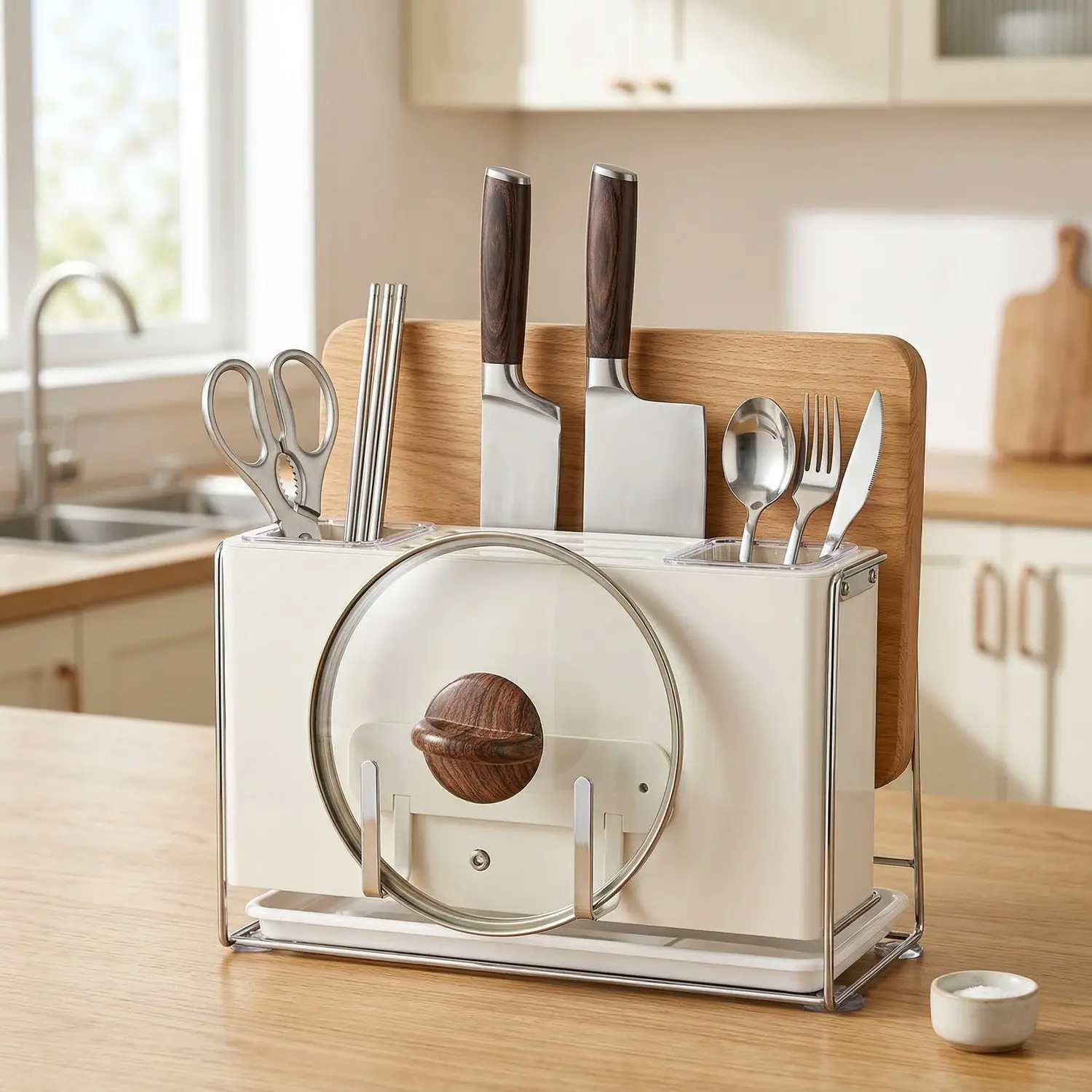
1. Magnetic wall knife strip instead of a knife block. The knife block is one of the most space-inefficient items on any counter — occupying six to eight inches of prime surface while also being the hardest counter item to properly clean. A wall-mounted magnetic strip moves your knives to vertical wall space, keeps blades accessible in under two seconds, and actually extends blade longevity by eliminating the wood-on-metal abrasion of block slots. The MagniStore Magnetic Wall Knife Rack at $15.99 adds an integrated chopstick holder and utensil bar, consolidating what were three separate counter items into a single wall installation.
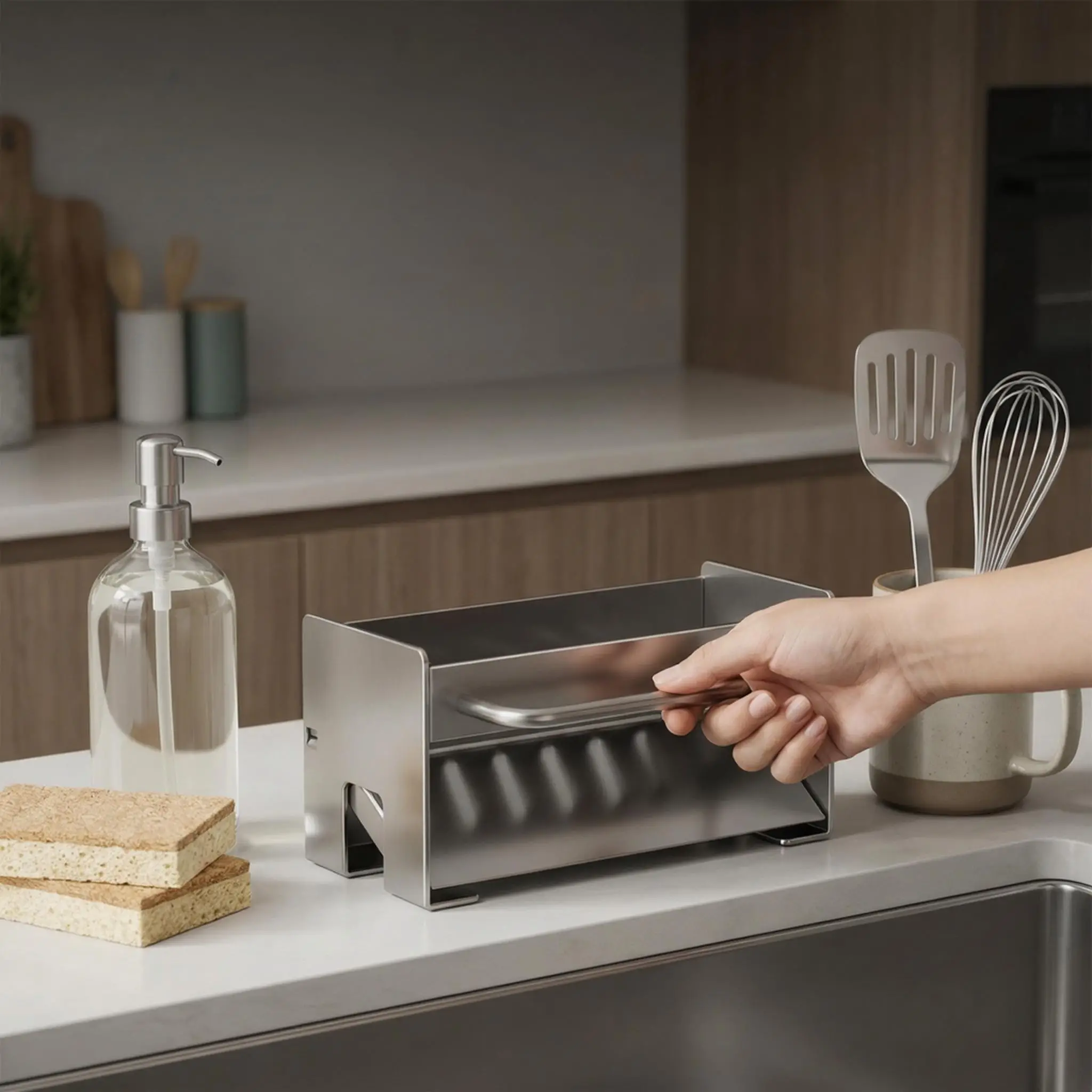
2. Self-draining sink caddy for the dish area. The zone around your sink is perpetually cluttered with wet sponges, soap, scrubbers, and brushes — a hygiene problem as well as an organisation one. A self-draining caddy consolidates all of these into a single footprint with a channel that removes standing water. The HydroFlow Sink Caddy at $14.99 holds sponge, brush, dish soap, and scrubber in one place, replacing four scattered items with one compact unit while actively improving sink-area hygiene.
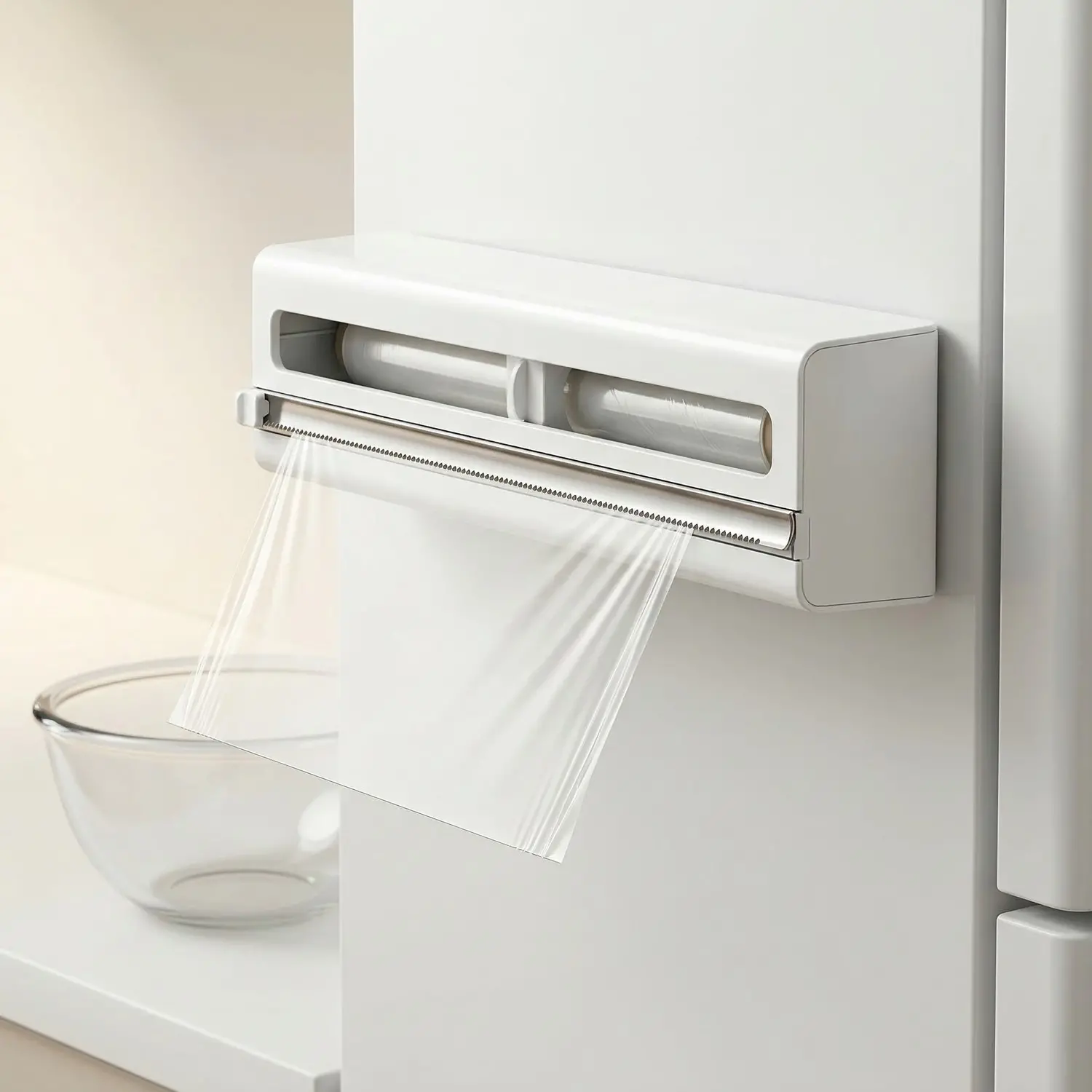
3. Fridge-mounted film and foil dispenser. Cling film, aluminium foil, and baking paper are among the most awkward items in any kitchen drawer — they roll, jam, and create chaos whenever you reach in for something else. Moving them to a fridge-mounted magnetic dispenser like the MagCut Magnetic Cling Film Cutter at $13.99 removes them from drawers entirely and positions them right where you use them — at the counter adjacent to the fridge. The built-in cutter delivers clean, straight cuts, eliminating the tearing frustration of box-edge cutters.
4. Cabinet-door hooks and over-door organisers. The inside surface of cabinet doors is consistently the most underutilised storage real estate in the average kitchen. Command-strip hooks handle pot lids, measuring cups, and lightweight utensils without drilling. Over-door wire organisers mount in minutes and hold cleaning supplies, snack items, spice packets, or small containers. This converts wasted dead space into meaningful storage capacity without any permanent modification to cabinets.
5. Drawer-size food sealer instead of a counter gadget. Food sealers and bag clip collections frequently end up on the counter because they are used regularly but do not fit tidily in drawers. The PocketSeal Wireless Mini Food Sealer at $15.99 is compact enough to live in a kitchen drawer permanently — rechargeable, cordless, and taking no counter footprint at all while handling everything a full-size sealer unit can do.
The Products That Make It Stick
Decluttering without the right physical infrastructure is temporary at best. These three products address the highest-impact counter zones in most kitchens — the knife and utensil area, the sink zone, and the wrap and foil storage problem.
1
Best Counter Reclaim
MagniStore Magnetic Wall Knife Rack
$15.99
Removes your knife block from the counter permanently and mounts to the wall using the vertical space kitchens always have available. The integrated chopstick holder and utensil bar mean one installation replaces three separate counter items. Strong neodymium magnets hold blades securely with no wobble, and the open-air display is far easier to clean than a wood block — making it a genuine hygiene upgrade as well as a spatial one. Wall-mounting takes under 15 minutes.
2
Best Sink Zone Fix
HydroFlow Sink Caddy with Drainer
$14.99
A self-draining caddy that consolidates sponge, scrubber, brush, and soap into a single compact footprint. The drainage channel removes standing water that causes sink-area bacterial growth — a measurable hygiene improvement as well as an organisational one. Replaces the habitual scatter of four individual items across your sink rim and adjacent counter surface. The contained footprint also makes wiping the surrounding counter area significantly faster.
3
Best Drawer Saver
MagCut Magnetic Cling Film Cutter
$13.99
Mounts to your fridge door with a strong magnet and keeps cling film accessible right where you actually use it — beside the prep surface. Eliminates the tangled, jamming drawer problem that plagues cling film storage entirely. The integrated serrated cutter produces clean, straight cuts without the frustration of cardboard box edges. A small investment that permanently solves one of the kitchen’s most reliably annoying daily friction points.
Frequently Asked Questions
How do I stop the counter from filling up again within a week of clearing it?
The single most reliable maintenance method is what professional organisers call a ten-minute evening reset — done every night before leaving the kitchen. Every item gets returned to its designated storage location, the counter surface gets wiped down, and the space resets for the morning. The word “designated” is critical here: if items do not have a specific, named place to return to, they will always default back to the counter. Sunday’s installation work — creating landing zones, installing wall-mounted storage, establishing homes for every category — is what makes the evening reset take ten minutes rather than thirty.
I have a very small kitchen. Can I realistically have clear counters?
Small kitchens benefit the most from this process because the stakes of every wasted inch are higher. The principles are identical but the execution tilts more aggressively toward vertical and non-counter space: wall-mounted knife strips, fridge-door organisers, tension rods inside cabinets for lid storage, under-shelf hanging baskets, and magnetic spice racks on available wall surfaces can collectively add the functional equivalent of several square feet of storage without structural changes. In a small kitchen the goal often shifts from “clearing some counter space” to “eliminating counter use entirely except for active food preparation.”
Should I get rid of appliances I do not use every day?
Not necessarily — but they absolutely should not live on the counter. Appliances used fewer than three times per week belong in a cabinet, retrieved when needed. Appliances used fewer than once a month belong in longer-term storage or should be donated. The test is simple: if that appliance were inaccessible for six months, would you genuinely miss it? If the honest answer is no, it is a donation candidate. If yes, it simply needs a better home than your counter surface. The physical effort of retrieving a stored appliance takes thirty seconds — that is a cost worth paying to reclaim premium prep space year-round.
Do all decorative items have to go?
No — but they need to earn their space through the same lens as functional items. One or two carefully chosen objects — a small living plant, a ceramic oil bottle you genuinely love, a framed card leaning against the backsplash — can make a kitchen feel warm and personal without contributing to functional clutter. The problem with decoration is that it accumulates passively: one item at a time is added and nothing is ever removed. The earn-your-space rule applies to decorative items equally: if a piece no longer actively delights you when you see it, it is no longer earning its square inches and it is time to move it on.
✅ The Verdict
A clear kitchen counter is not a luxury reserved for people with large kitchens, professional organisers on speed dial, or unnaturally disciplined households. It is an achievable outcome for any home — using one focused weekend, a handful of targeted storage tools, and a simple daily reset habit. Saturday gives you the clear slate. Sunday gives you the systems. The earn-your-space rule and the right wall-mounted solutions make it permanent. Your kitchen is where you feed yourself and your household every single day; it deserves the thirty minutes it takes to make it actually work for you.
Ready to Transform Your Kitchen?
Browse our full range of kitchen organisation and storage solutions — built for real kitchens, real budgets, and results that last.

About author