No products in the cart.
How to Travel with Your Cat Without the Stress
Pet Supplies
How to Travel with Your Cat Without the Stress
Most cats don’t hate travel — they hate the way we introduce it. Here’s how to change that, step by step.
Here’s a hard truth most cat owners don’t hear until they’re already in the car with a yowling, distressed feline: your cat’s travel anxiety isn’t inevitable. In most cases, it’s the result of how travel was introduced — usually abruptly, with no preparation, inside a carrier they’ve never seen before today. According to the American Veterinary Medical Association (AVMA), preparing your cat well in advance of any trip — including acclimating them to their carrier — dramatically reduces travel-related stress.
Cats are creatures of habit and territorial security. The moment you remove them from their known environment without preparation, their stress response kicks in hard. But here’s the good news: that stress response can be significantly reduced — or eliminated — with the right approach. Whether you’re planning a road trip, a flight, or a vet visit, this guide walks you through everything vets and feline behavior specialists actually recommend for stress-free cat travel in 2026.
“Fear and anxiety during travel is one of the most common concerns we hear from cat owners — and it’s almost always preventable with gradual desensitization and proper carrier training.”
— Dr. Mikel Delgado, PhD, Certified Cat Behavior Consultant
📋 Table of Contents
Understanding Why Cats Get Stressed During Travel
Cats are fundamentally different from dogs when it comes to travel. While many dogs generalize positive associations with car rides and novelty, cats rely on scent-marked territory for their sense of security. The moment you lift a cat out of that territory, you’ve removed their primary safety signal.
Travel stress in cats typically manifests through several overlapping systems:
- Motion sensitivity: Cats have a highly sensitive vestibular system. The movement of a car can trigger nausea and disorientation, especially for cats who rarely travel.
- Sensory overload: Unfamiliar sounds, smells, and visual stimuli bombard them from every direction.
- Loss of control: Cats strongly prefer to choose where they go. Confinement in a moving box violates every instinct they have about escape and safety.
- Negative associations: If the only times a carrier appears are before vet visits, cats rapidly learn that the carrier = something unpleasant is coming.
The good news? All of these are addressable. Understanding the root cause is step one. The rest of this guide is step two through ten.
Choosing the Right Carrier: Hard vs Soft, Size Guide & Vet Recommendations
The single most important piece of gear for cat travel is the carrier — and the wrong one can make everything harder. Here’s what actually matters:
Hard-sided vs Soft-sided Carriers
Hard-sided carriers (plastic shells with wire doors) offer better crash protection, are easier to clean, and tend to feel more secure because the walls don’t flex. Most vets recommend them for car travel and flying in cargo. The downside is they can be bulkier and heavier.
Soft-sided carriers (fabric construction, mesh panels) are lighter, easier to store, and often more comfortable for in-cabin airline travel. Some cats prefer them because the softer walls feel less rigid. However, they offer less structural protection in an accident.
For most owners, a two-door hard carrier that opens from both the top and front is the best all-around choice. Top-loading access is crucial because it allows you to lower your cat in gently from above rather than forcing them through a front door — a significant stress reducer during loading.
Size: The Goldilocks Problem
The carrier should be large enough for your cat to stand up, turn around, and lie down comfortably — but not so large that they slide around during motion. A general rule: the carrier should be approximately 1.5 times the length of your cat from nose to base of tail. Too big and the cat loses the “den” feeling that actually helps them feel secure.
What Vets Actually Recommend
The American Association of Feline Practitioners (AAFP) recommends leaving the carrier out as a permanent piece of furniture in the home — not just appearing on travel days. Add familiar bedding and treats inside. This single change reduces carrier-loading stress dramatically by changing the carrier from “threat” to “familiar furniture.”
Carrier Training — The Step-by-Step 4-Week Method
This is where most owners skip ahead and pay for it later. Carrier training is not optional if you want a calm cat during travel. Done right, it takes about 4 weeks and requires only a few minutes of effort each day.
Week 1: Introduction & Familiarity
💡 Week 1 Goal: Make the carrier a permanent, unremarkable part of the room. Place it in a spot your cat frequents. Leave the door open. Put their favorite blanket or an item of your clothing inside. Do nothing else — don’t force them in. Just let curiosity do the work.
By the end of week 1, most cats will have sniffed the carrier thoroughly and some will have entered voluntarily. Reward any approach with calm praise and treats placed near (not inside) the carrier.
Week 2: Positive Associations
💡 Week 2 Goal: Feed your cat their meals near and eventually inside the carrier. Start with the food bowl just outside, move it to the doorway, then fully inside over the course of the week. Never close the door during this phase.
Cats that eat inside their carrier voluntarily have crossed a major psychological threshold. The carrier is now associated with food reward — one of the strongest positive reinforcers available.
Week 3: Door Practice
💡 Week 3 Goal: Begin briefly closing the door while your cat eats inside, then immediately opening it again. Gradually extend the time — from 5 seconds to 30 seconds to a few minutes. Pair each closing with high-value treats (freeze-dried chicken or tuna work well).
Week 4: Motion Simulation
💡 Week 4 Goal: With your cat comfortable inside the closed carrier, carry it to a different room, then bring it back. Then try a 5-minute car trip to nowhere. Then a 15-minute drive. Build duration slowly. This desensitizes them to the motion and sounds of travel.
Cats that complete this 4-week process typically show dramatically reduced travel anxiety. Some become completely relaxed travelers. Don’t rush any phase — if your cat shows stress, slow down and go back a step.
70%
of cats show measurable travel anxiety signs without prior carrier training
of cats show measurable travel anxiety signs without prior carrier training
2–4×
Average annual vet trips per cat — making carrier comfort a year-round necessity
Average annual vet trips per cat — making carrier comfort a year-round necessity
4 wks
The typical time needed to fully carrier-train an adult cat using positive reinforcement
The typical time needed to fully carrier-train an adult cat using positive reinforcement
The Day of Travel — What to Do (and Not Do)
Even a well-trained cat benefits from a consistent pre-travel routine. Here’s how to stack the deck in your favor:
Do
- Withhold food for 3–4 hours before travel to reduce the chance of motion sickness (water is still fine).
- Spray the carrier interior with Feliway Classic (synthetic feline pheromone) at least 30 minutes before loading — it genuinely works for many cats.
- Place a recently worn item of your clothing in the carrier for familiar scent comfort.
- Cover the carrier with a light blanket on the sides — visual privacy reduces stimulation overload.
- Keep the car temperature comfortable — cats are sensitive to heat, especially when confined.
Don’t
- Don’t chase your cat to get them in the carrier — this creates a negative memory that sets back all your training.
- Don’t play loud music — keep the car quiet or use low, calm background music.
- Don’t let the carrier slide around — secure it with a seatbelt or place it in the footwell against a seat.
- Don’t open the carrier while the car is moving — even a calm cat can panic when the car stops suddenly.
- Don’t sedate your cat without vet guidance — over-the-counter sedatives can be dangerous for cats.
Road Trips vs Flying with Cats: What Changes
The fundamentals of cat travel stress are the same whether you’re driving or flying — but the logistics differ considerably.
Road Trips
Road trips give you the most control. You set the pace, you control the temperature, and you can stop when needed. For long drives, plan rest stops every 2–3 hours. Bring a portable litter tray and offer water at each stop (most cats won’t drink while moving). Keep a blanket over the carrier except during stops. If your cat is particularly anxious, ask your vet about prescription anti-anxiety medication like gabapentin, which is commonly used and well-tolerated in cats.
Flying with Cats
Flying is significantly more stressful to manage — both for the cat and the owner. Key rules:
- In-cabin is always preferable to cargo for cats. Most airlines allow cats in cabin (under 20 lbs including carrier) for a fee of $95–$150 each way.
- Verify your specific airline’s policy before booking — restrictions on breeds, carrier dimensions, and number of pets per cabin vary.
- Book a direct flight whenever possible — connections dramatically increase stress duration.
- Visit the vet before flying to get a health certificate (usually required within 10 days of travel) and discuss anxiety management options.
- Do not sedate without veterinary guidance — sedation at altitude can affect breathing and is often explicitly prohibited by airlines.
Making the Destination Feel Safe
The journey is only half the battle. When you arrive at a new location — whether a vacation rental, a friend’s house, or a new home — your cat needs a structured introduction period to feel safe.
The golden rule: start small. Confine your cat to a single room initially — ideally with their carrier left open as a refuge, along with their familiar litter box, water, and bedding. Let them investigate that room fully before opening up more of the space. This mirrors the way cats naturally expand their territory in the wild, and it drastically reduces the panic response.
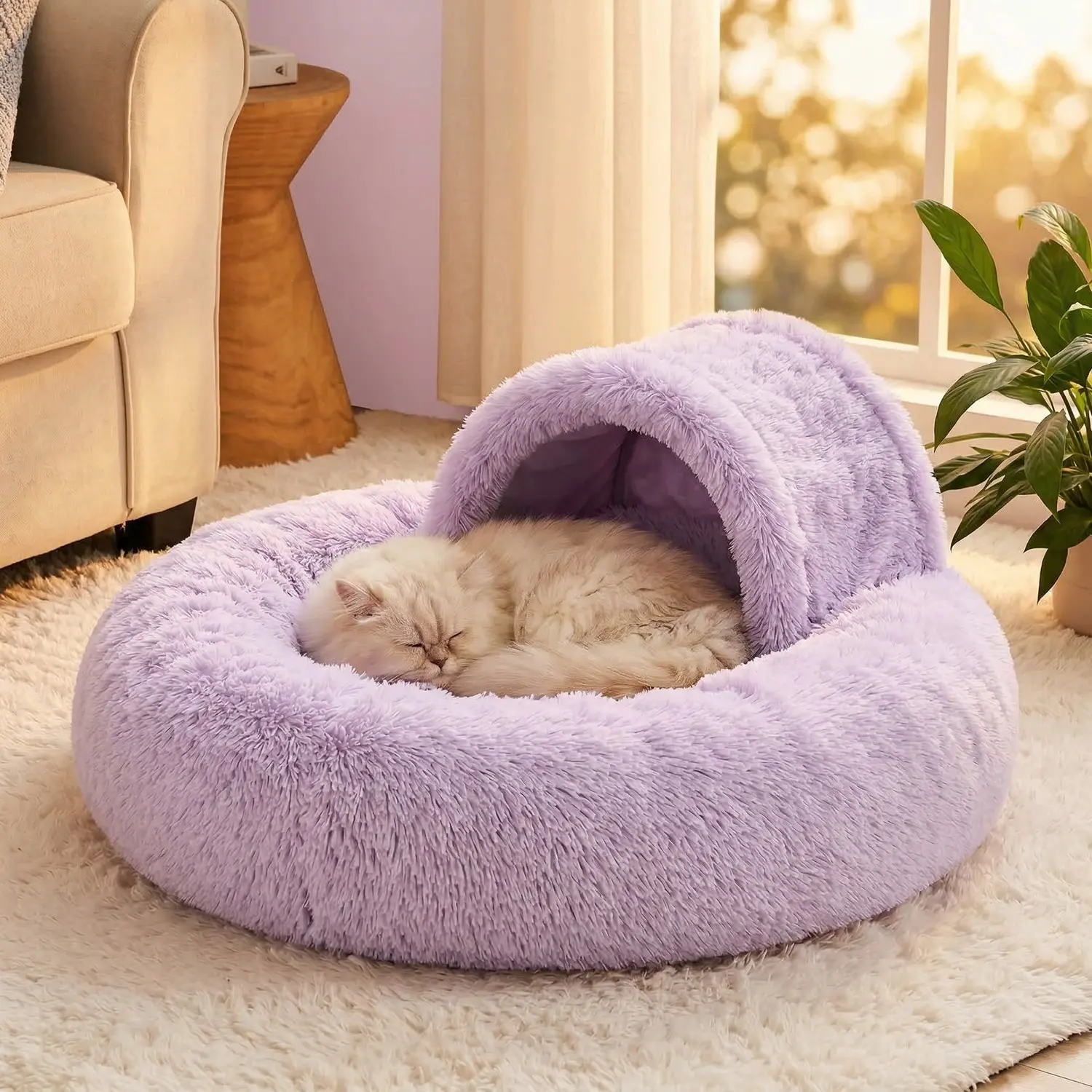
One of the best investments you can make for travel comfort is a high-quality, familiar-smelling cat bed that travels with you. The CozyNest All-Season Cat Bed is a great option here — its donut tunnel design mimics the enclosed, cozy hideaways cats naturally seek when stressed, and the self-warming felt holds their familiar scent. At just $12.99, it’s a low-cost way to give your cat a portable “home base” that travels with them and smells like their territory from the moment they arrive.
Bring a few familiar toys as well — the interactive play they provide is one of the fastest ways to burn off nervous energy and shift a stressed cat into a more relaxed state. The PlayPaw Tumbler Cat Toy Set packs three toys in one for under $4 — the tumbler, wand, and catnip ball all target different play instincts, which is ideal for keeping a displaced cat occupied and calm.

Products to Pack for Cat Travel
Beyond the carrier itself, a few well-chosen products make cat travel meaningfully smoother. Here are our top picks:
1
Best for Comfort
CozyNest All-Season Cat Bed
$12.99
Donut tunnel design with self-warming felt — gives anxious cats a familiar, enclosed refuge at the destination. Lightweight enough to pack in any bag and machine washable. The scent retention is the real selling point: after a week at home, it carries your cat’s own scent markers, making it instantly comforting in a new environment.
2

Best for Calm
PlayPaw Tumbler Cat Toy Set
$3.99
Three interactive toys (self-righting tumbler, wand, catnip ball) that target different play instincts — perfect for burning off anxious energy at the destination. Compact enough to throw in any bag. At under $4, it’s one of the best-value tools for transitioning a stressed cat into a relaxed, curious state in a new environment.
Frequently Asked Questions
How long does it take to carrier-train an adult cat?
Most adult cats can be carrier-trained in 3–4 weeks using a consistent positive reinforcement approach. Some cats — particularly those with prior negative travel experiences — may take 6–8 weeks. Patience and avoiding rushing any phase is more important than speed. Kittens under 6 months often adapt significantly faster.
Can I give my cat Benadryl to calm them for travel?
We strongly advise against using any over-the-counter human medication for cats without specific veterinary guidance. While diphenhydramine (Benadryl) is sometimes used by vets in very specific circumstances, dosing errors are dangerous. Better options include Feliway pheromone spray, prescription gabapentin (vet prescribed), or natural supplements like Zylkene — all of which are both safer and more effective for feline travel anxiety.
Is it safe to travel by plane with a cat in cargo?
While millions of pets travel in cargo each year without incident, it carries significantly more risk than in-cabin travel and should be avoided if possible. The cargo hold can experience extreme temperature fluctuations, pressure changes, and is inherently more stressful. If your cat is too large for in-cabin travel, consult your vet about sedation protocols and consider ground transportation as a safer alternative for long distances.
My cat cries the entire car trip — is this always stress, or could something be wrong?
Persistent vocalization during travel is almost always stress-related, but if your cat also shows signs of drooling, panting, extreme lethargy, or vomiting repeatedly, it’s worth a vet visit to rule out vestibular issues or motion sickness that may need medical management. For most cats, however, it’s behavioral — and fully addressable with the carrier training and preparation methods described in this guide.
✅ The Verdict
Cat travel anxiety is real — but it is not permanent. The vast majority of cats can learn to tolerate, and many can genuinely enjoy, travel when introduced correctly. The carrier training 4-week protocol is the single most impactful thing you can do. After that, everything else — the pheromones, the familiar bedding, the slow introduction to new spaces — layers on top of that foundation. Start now, before your next trip. Your future self (and your cat) will thank you.
Shop All Pet Travel Essentials
From cozy travel beds to interactive toys — everything your cat needs for a calmer, happier journey.


About author