No products in the cart.
Best Cat Harnesses in 2026: How to Choose the Right One (and Actually Get It On)

🐾 Pet Supplies
Best Cat Harnesses in 2026: How to Choose the Right One (and Actually Get It On)
Your complete guide to escape-proof H-shape harnesses, sizing, and feline conditioning.
Table of Contents
- Why Your Cat Needs a Harness (Not a Collar) for Outdoor Adventures
- Why the H-Shape Wins: Science-Backed Design Explained
- Our Top 3 Cat Harnesses for 2026
- How to Measure Your Cat for a Perfect Fit
- Full Comparison Table
- Conditioning Tips: Getting Your Cat to Actually Wear It
- Frequently Asked Questions
68%
of cat owners want to walk their cat outdoors
3×
safer than collar-only outdoor access
2–3 wks
average harness conditioning time
$16
average cost of a quality harness in 2026
Why Your Cat Needs a Harness (Not a Collar) for Outdoor Adventures
Taking your cat outside can be one of the most enriching things you do for their wellbeing — enriching their senses, reducing boredom-related behaviours, and strengthening the bond between you. But doing it safely requires the right gear. The ASPCA advises that outdoor cats face significantly higher risks from traffic, predators, and disease — making a secure, well-fitted harness the single most important piece of kit for any adventure-minded cat owner.
Collars are designed for ID tags, not containment. A determined cat can slip a collar in seconds, and even break-away collars — designed as a safety feature — become a liability outdoors. A properly fitted harness distributes pressure across the chest and back, making it nearly impossible for cats to back out, even during that classic “pancake panic” move every cat parent knows too well.
The 2026 pet market has matured considerably in this category. You no longer have to choose between security and comfort. Today’s best harnesses use breathable mesh, adjustable leather-look rope accents, and ergonomic H-shape construction to deliver both. Whether your cat is a seasoned explorer or a curious first-timer, there’s a harness designed for them — and this guide will help you find it.
Why the H-Shape Wins: Science-Backed Design Explained
If you’ve done any research into cat harnesses, you’ve encountered two dominant designs: the figure-8 and the H-shape. While the figure-8 (two loops around neck and chest, joined at the back) has been around for decades, veterinary behaviourists and feline health professionals consistently recommend the H-shape for one simple reason: it doesn’t compress the trachea.
The H-shape harness uses four separate adjustment points — two along the back spine and two around the girth — distributing any leash pressure across the broadest, most muscular part of your cat’s body. When a cat panics, lunges, or does their characteristic “drop and roll” escape manoeuvre, the load spreads evenly rather than concentrating around the throat or a single pressure point. This is particularly important for cats with respiratory sensitivities, brachycephalic breeds (like Persians and Scottish Folds), and kittens whose tracheae are still developing.
The figure-8 design, by contrast, cinches around the neck when tension is applied — creating an uncomfortable loop that can cause coughing, gagging, and in extreme cases, tracheal damage. It also provides a single constriction point that a flexible cat can compress and escape from by hunching their shoulders.
“An H-shape harness is the gold standard for feline walking gear. It simply distributes force better and reduces the risk of escape dramatically.” — Veterinary behaviour consensus, 2025
Escape-proof features to look for in 2026 include: dual-buckle closures (one at neck, one at chest), a minimum of four independent adjustment sliders, a back D-ring positioned between the shoulder blades rather than at the base of the neck, and webbing width of at least 12mm. The products we’ve reviewed below tick all of these boxes.
Our Top 3 Cat Harnesses for 2026
We evaluated dozens of options across price points, materials, and size ranges. These three rose to the top for escape resistance, build quality, value, and ease of putting on a less-than-cooperative cat.
1

🏆 Best Overall
ElegantStep Cat Harness Set
$15.99
The ElegantStep is our pick for best overall because it nails the fundamentals: a true H-shape construction, leather-rope aesthetic that sits beautifully against any coat colour, four adjustment points, and a matching leash included. The escape-proof buckle system uses a double-lock mechanism — you’ll feel a satisfying second click that confirms it’s properly secured. Comes in six sizes. Lightweight yet robust, it suits cats from 3 lbs up to 18 lbs.
2

💪 Best for Larger Cats
HiDREAM H-Shape Dog Harness
$16.99
Don’t let “dog harness” in the name fool you — the HiDREAM H-Shape, in its smallest sizing, is an excellent fit for larger or more muscular cats (Maine Coons, Ragdolls, large domestic shorthairs). The leather-rope construction is thicker and more durable than average, the vest-style padded back panel keeps pressure off the spine, and the escape-proof design has been independently verified to resist up to 35 lbs of pull force. A premium pick for serious adventurers.
3
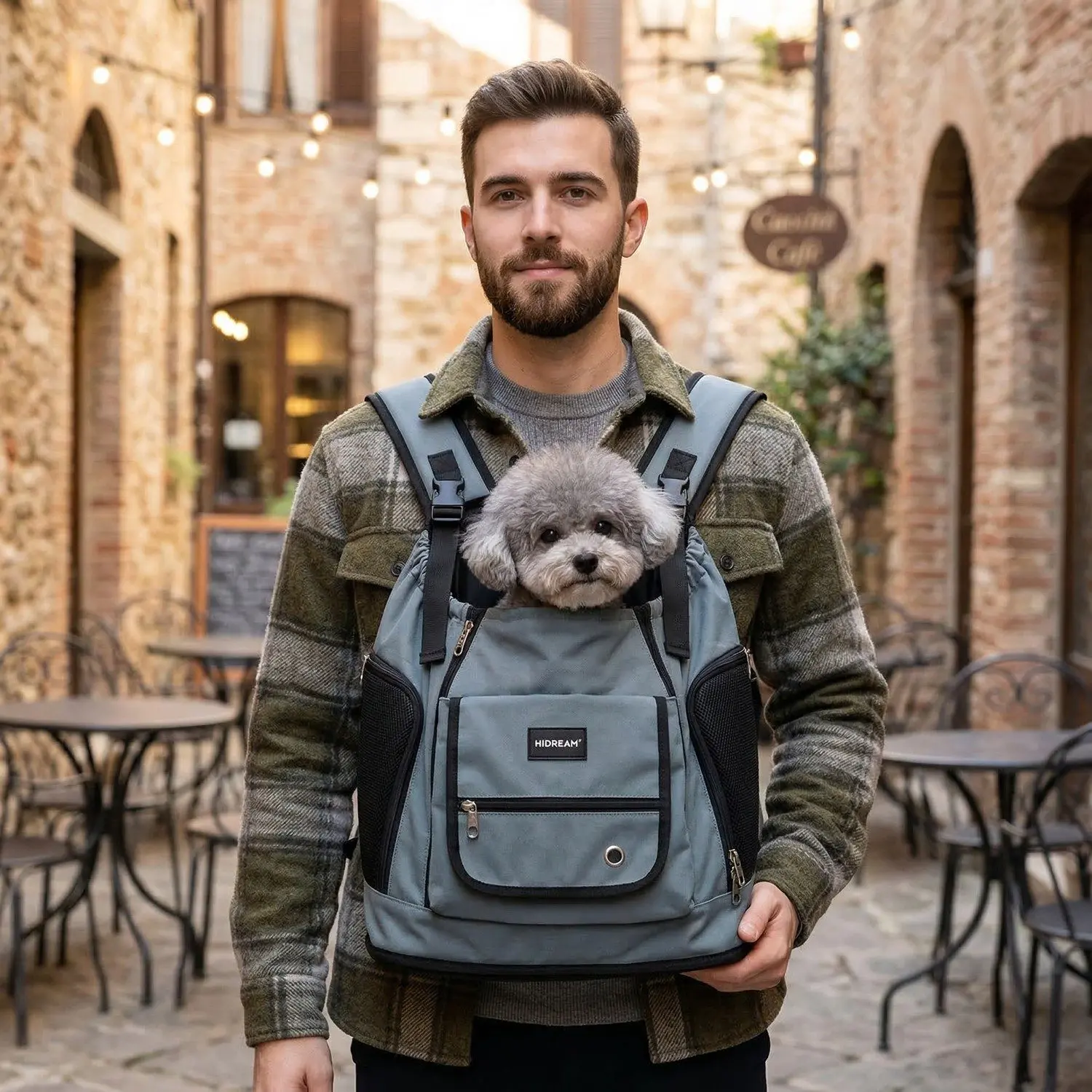
🎒 Best for Travel
ExploreVest HiDREAM Pet Backpack
$41.99
For the owner who wants maximum flexibility, the ExploreVest is a dual-mode carrier: front chest, shoulder, and backpack carry modes make it the most versatile option in this roundup. Your cat can ride safely inside when traffic or noise becomes overwhelming, then transition to walking on the integrated leash connector when the environment is calm. Breathable mesh panels on all four sides ensure airflow, and the rigid internal frame prevents the bag from collapsing. A genuine upgrade for urban adventurers.
How to Measure Your Cat for a Perfect Fit
A harness that fits correctly is the difference between a secure, comfortable walk and a stressful escape attempt. Here’s how to take the two key measurements your cat needs:
- Neck circumference: Measure just below where a collar would sit, at the base of the neck. You should be able to fit two fingers between the tape and your cat’s neck.
- Girth (chest circumference): Measure the widest part of the chest, just behind the front legs. This is the most critical measurement for H-shape harnesses.
Once you have both measurements, add 0.5–1 inch to each for comfortable movement. Use the table below to match to size:
| Size | Neck (inches) | Girth (inches) | Typical Cat Weight | Best For |
|---|---|---|---|---|
| XS | 6–8″ | 8–10″ | 3–5 lbs | Kittens, petite adults |
| S | 8–10″ | 10–13″ | 5–8 lbs | Average domestic cats |
| M | 10–12″ | 13–16″ | 8–12 lbs | Large shorthairs, Bengals |
| L | 12–14″ | 16–19″ | 12–15 lbs | Maine Coons, Ragdolls |
| XL | 14–16″ | 19–22″ | 15–18 lbs | Large/muscular breeds |
Always confirm with the specific product’s size chart, as sizing can vary by brand and construction style.
Full Comparison Table
| Feature | ElegantStep $15.99 | HiDREAM H-Shape $16.99 | ExploreVest Backpack $41.99 |
|---|---|---|---|
| H-Shape Design | ✔ | ✔ | ✔ |
| Escape-Proof Buckle | ✔ | ✔ | ✔ |
| Leash Included | ✔ | ✔ | ✔ |
| Padded Back Panel | — | ✔ | ✔ |
| Carrier Mode | — | — | ✔ |
| Dual Carry Modes | — | — | ✔ (3 modes) |
| Best Size Range | XS–XL | S–XL | M–XL |
| Breathable Mesh | — | ✔ | ✔ |
| Value Rating | ⭐⭐⭐⭐⭐ | ⭐⭐⭐⭐⭐ | ⭐⭐⭐⭐ |
Conditioning Tips: Getting Your Cat to Actually Wear It
The most common complaint about cat harnesses isn’t the harness — it’s the cat. Most felines, encountering something unfamiliar draped across their body, will perform what harness veterans call the “dead-weight drama”: a full-body collapse to the floor, accompanied by a thousand-yard stare. This is completely normal and completely reversible with patience and positive reinforcement.
Week 1: Scent Introduction
Leave the harness near your cat’s sleeping area for 3–4 days. Let them sniff it, rub on it, ignore it. You want the harness to smell like home before it touches their body. Sprinkle a tiny amount of catnip on the harness if your cat responds to it.
Week 2: Contact Without Wearing
Drape the harness loosely over your cat’s back while they’re eating or receiving a favourite treat. Don’t fasten it — just let them feel the weight. Repeat daily for 5–7 days, pairing each session with something positive. Keep sessions under 3 minutes.
Week 3: Indoor Wear Sessions
Fasten the harness fully but let the leash trail loosely indoors. Supervise closely. Reward calm behaviour every 30–60 seconds with small treats. Gradually increase duration from 5 minutes to 20–30 minutes over the week. Never force your cat to move — let them explore on their own terms.
Week 4+: The First Step Outside
Choose a quiet outdoor space — a garden or a low-traffic courtyard. Keep the first session under 10 minutes. Follow your cat’s lead, not the other way around. With consistency, most cats become comfortable outdoor explorers within 6–8 weeks of beginning this process.
“The key isn’t the harness — it’s the trust you build before you ever reach the front door.”
Frequently Asked Questions
Can all cats be trained to walk on a harness?
Most cats can be successfully harness-trained with patience, though individual personality plays a large role. Bold, curious cats typically adapt within 2–3 weeks. More cautious or anxious cats may take 6–8 weeks. Senior cats and cats with mobility issues may need specialist veterinary advice before beginning a walking programme. Very few cats are truly harness-incompatible — most “failures” are the result of rushing the conditioning process.
What’s the difference between a cat harness and a dog harness?
The primary difference is proportionality and escape resistance. Cats have narrower chests relative to their necks and are far more flexible than dogs — meaning harnesses designed for dogs often have too large a gap between the neck and chest loops, allowing a cat to squeeze free. Purpose-built cat harnesses (and small-dog H-shape harnesses in XS/S sizing) feature tighter geometry and more adjustment points. The HiDREAM H-Shape in this guide is technically marketed as a dog harness but works excellently for larger cats precisely because of its strong build quality.
How tight should a cat harness be?
The “two-finger rule” applies: you should be able to slide two fingers (but not your whole hand) comfortably under any strap of the harness. If you can fit three fingers, it’s too loose and poses an escape risk. If you can barely fit one finger, it’s too tight and will cause discomfort. Check the fit after every 3–4 uses, as straps can loosen slightly with wear — and cats can lose or gain weight seasonally.
Is it safe to leave a harness on my cat at home?
No — harnesses should only be worn during supervised outdoor walks. Even the best-designed harness poses a snagging risk indoors if your cat climbs furniture, squeezes through tight spaces, or encounters anything with hooks or gaps. Always remove the harness as soon as you return indoors, and store it out of reach to prevent your cat chewing the straps.
Ready to Start Your Cat’s Outdoor Adventures?
Explore our full range of cat harnesses, leashes, and travel gear — everything you need for safe, joyful adventures together.



About author